
Quality Control Checkpoints in a Car and Air-Care Fragrance Run
In car and air-care production, most quality failures are visible before anything smells wrong. A reservoir that is overfilled, a wick that sits a millimetre too low, a housing with a moulding flash on the sealing face: each of these ends as a complaint about scent strength, even though the fragrance was never at fault. A useful QC plan therefore inspects the delivery system with as much attention as the liquid, and it defines the checkpoints in production order so that a problem is caught while it is still cheap.
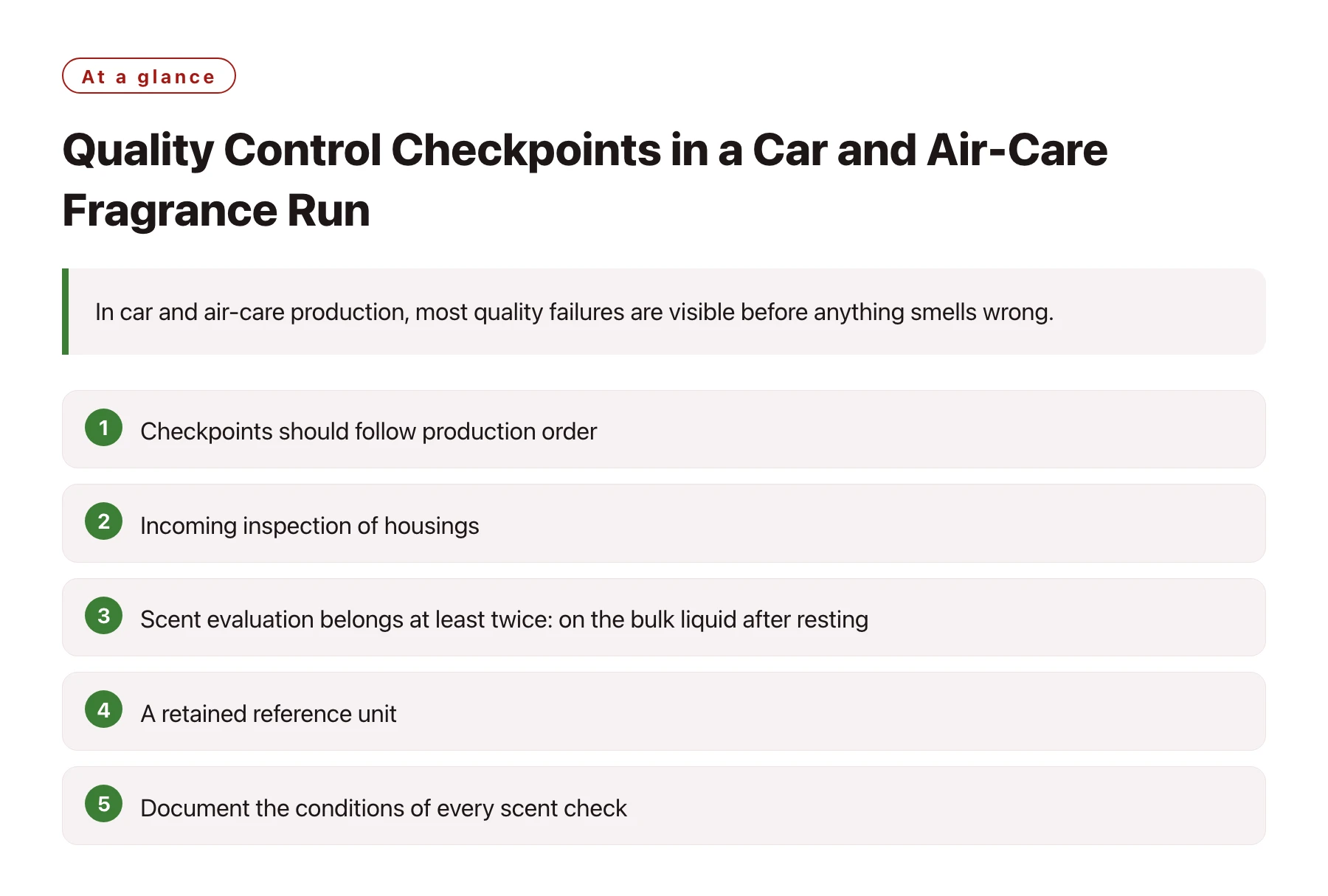
Key takeawaysCheckpoints should follow production order, so each gate can stop the line rather than report a fault after packing. · Incoming inspection of housings, wicks, films and closures catches more defects than any later stage, because those components set the release behaviour. · Scent evaluation belongs at least twice: on the bulk liquid after resting, and on a finished unit after a defined conditioning period. · A retained reference unit, sealed and dated, is the only reliable way to settle a complaint about strength or character months later. · Document the conditions of every scent check, since temperature, airflow and the assessor's recent exposure all change the reading.
Quality control in air care is often written as a list of tests attached to a batch. That is the wrong starting point. The more useful document is a list of gates, each with an owner, a criterion and an action if the criterion fails. Tests without a gate become records nobody acts on.
This article sets out the gates in the order they occur on a car or home fragrance line, written from the perspective of the person who signs the release at a niche fragrance house. It also sets out which defects each gate exists to catch, because a checkpoint that catches nothing is overhead.
The checkpoints, in production order
- Incoming component inspectionCheck housings, wicks, films, seals and closures against drawings and the approved sample, with dimensions, material grade and moulding defects recorded per lot.
- Incoming fragrance and carrier verificationConfirm the composition version, the batch number, the safety documentation and the retained sample from the fragrance house before the drum is opened.
- Compounding and resting checkVerify weights and sequence, record the batch, and confirm the resting period. Several materials change noticeably over the first days, so evaluating too early produces a false reading.
- In-process fill and assembly checkCheck fill weight on a defined sample size, verify wick or membrane position, and inspect the sealing face before the closure goes on.
- First-article evaluation on the finished unitEvaluate release and character on a finished unit in the real housing, not on a blotter, and record the conditioning time before the assessment.
- Leak, drop and thermal cycle checkRun the agreed protocol on a sample from the lot, with the temperature range and the number of cycles written into the specification.
- Packing and label verificationVerify artwork version, warnings, batch coding and the packing configuration against the approved specification before the pallet is closed.
- Reference sample retentionSeal a unit from the lot, label it with the batch, the date and the composition version, and store it with the batch record.
The defect each checkpoint exists to catch
| Symptom reported by customers | Likely root cause | Checkpoint that should have caught it |
|---|---|---|
| Scent too weak from the first day | Underfilled reservoir, recessed wick, or a barrier film left in place. | In-process fill and assembly check. |
| Scent strong for a week, then gone | Release rate mismatched to the intended life, often from a component substitution. | Incoming component inspection and first-article evaluation. |
| Visible staining on a dashboard or a shelf | Leak at the seal, or material incompatibility between the liquid and the housing. | Leak and thermal cycle check, supported by compatibility testing at development. |
| Scent smells different from the approved sample | A different composition version, or late substitution of a raw material. | Incoming fragrance verification and the retained reference. |
| Character changes after a few weeks in use | Oxidation or evaporation of the most volatile components, accelerated by heat. | Compounding and resting check, plus ageing evaluated during development. |
| Label or warning missing on part of the lot | Artwork revision not controlled at the packing station. | Packing and label verification. |
Read down the middle column and notice how much of it is component and version control rather than chemistry. That balance is typical of this product category, where the scent is often the most stable element in the system.
Making scent checks reproducible
Scent evaluation is the checkpoint most likely to become an opinion. Two assessors, a warm room and a recent coffee will produce a different reading from a cool room and a rested nose, and the difference is often larger than the batch difference being judged. Write the conditions into the procedure: who assesses, how many assessors, the temperature, the conditioning time after filling and the interval since the last sample.
The reference materials for the assessment have to be traceable too. Material data for fragrance ingredients is published in some depth, and a supplier that can point to a specification for the raw materials it used is easier to hold to account than one that cannot [1]. Where a restriction applies to a material, the assessment belongs in the file as well, because reformulation is one of the recognised reasons a bulk run drifts from an approved sample [2].
Training the assessment panel is the cheapest quality improvement available in this category. A panel that has practised describing intensity and character against a known set of references produces notes that can be compared across batches, while an untrained panel produces preferences. That is the practical argument for scent training, and professional scent training is a reasonable description of what such a programme sets out to build.
Where testing is outsourced, the conditions on the report matter as much as the result. Laboratory work on consumer products is scoped and dated, and a report without its scope is not evidence of anything [3]. Keep the scope with the report.
It is also worth separating the checks that protect the customer from the checks that protect the batch. Release testing protects the batch; incoming component inspection and version control protect the customer. Xuelei describes where the testing work sits in the wider production sequence, and the same logic applies here, with the housing added to the list.
Claims about a quality system are a starting point rather than evidence, whichever company makes them. Reference material about the company behind the fragrance museum is easy to find and easy to read, and the useful test is whether the documents you request match the scope that is described. A supplier whose paperwork arrives in the order it was promised is telling you something about how the next batch will be run.
Walk the line once and watch for the checkpoints that exist only on paper. A gate is real when somebody stops the line at it; a gate with a signature and no authority is a form, and the difference tends to show up in the second production run rather than the first.
Sources
- The Good Scents Company —— A reference database of aroma materials with odour descriptions, CAS numbers and typical usage information.
- IFRA: Safe Use and Fragrance Science —— IFRA's explanation of how fragrance materials are scientifically assessed for safe use and how those conclusions are applied by the industry.
- SGS: Cosmetics, Personal Care & Household Testing —— Testing, inspection and certification services for cosmetics and personal care, including microbiological, stability and safety testing aligned with cosmetics GMP.
Frequently asked questions
How often should scent be evaluated during a production run?
At least twice: on the bulk liquid after the resting period, and on a finished unit after a defined conditioning time. A single check at the end collapses two different questions into one reading.
Why do air-care complaints so often turn out to be mechanical?
Because release depends on the wick, membrane, fill level and housing fit. A small dimensional variation changes how much scent reaches the air, which customers experience as a weaker or stronger product.
What is the most useful piece of quality documentation after delivery?
The retained reference unit, sealed and dated, held with the batch record. It is what turns a subjective complaint into a comparison.
Should we ask for third-party testing on every batch?
No. Use internal release checks for routine control and reserve independent laboratory work for development, validation or a dispute, where a scoped and dated report carries more weight.
What makes a scent panel more reliable?
Written conditions, a small number of trained assessors, agreed reference materials and a record of each assessment. Training matters more than the number of people involved.
Get the 2013 story, retold four times a year.
Primary documents, oral histories and original reporting from the Louisville 2013 archive — delivered to 41,800 readers across 38 states and 12 countries.
Subscribe to the 2013 Archive